
Nobody hands you a maintenance schedule when you buy a Wüsthof. So most people wait until the knife is obviously bad, which is months past the point it should have been done.
How often should I get my knives sharpened?
TL;DR: For most home cooks, the knife you reach for daily wants a proper sharpening every six to twelve months. The rest of the block can usually go a year or two. Treat those numbers as a starting point, not a rule.
Here’s what moves that interval in either direction, and how to tell when yours has come due.
Where the numbers come from
The makers land in roughly the same place. Shun says once a year is often enough for many home cooks, and that you should sharpen only when honing no longer restores the edge (Shun). Wüsthof’s executive chef gives the same range, once or twice a year depending on use (Forbes).
Both add the same caveat, and it matters. Sharpening removes steel. A knife has a finite amount of blade in it. Sharpen on a schedule you don’t need and you’re spending its life for no reason.
So a year is the honest average. It’s also close to useless as a personal answer, because “average use” doesn’t exist in anyone’s kitchen.
Four things that move the number
How much you cook. Someone prepping dinner five nights a week is putting ten times the work through an edge as someone who cooks on weekends. Same knife, wildly different interval.
Your cutting board. This is the biggest variable people ignore. Glass, stone, ceramic, and countertop tile take the edge off a knife quickly. Wood or a medium-firm synthetic board is what a good knife wants, and it can double your time between sharpenings.
The steel. Hard Japanese knives (60 HRC and up, meaning the steel scores high on the Rockwell hardness scale) hold an edge far longer than softer German steel. Kai is direct about this: German knives get dull faster and need more maintenance (Shun FAQ). Your Konosuke and your Henckels are not on the same clock.
Whether you hone. A honing rod realigns an edge that has bent over in use. It removes no metal and creates no new edge. Done regularly, it stretches the interval a long way. Once the apex itself is worn away, honing does nothing, and that’s your signal.
How to tell without guessing
Three tests, thirty seconds:
Hold a sheet of printer paper by one corner and slice down through it. A keen edge glides and leaves a clean line. A tired edge snags, tears, or folds the page.
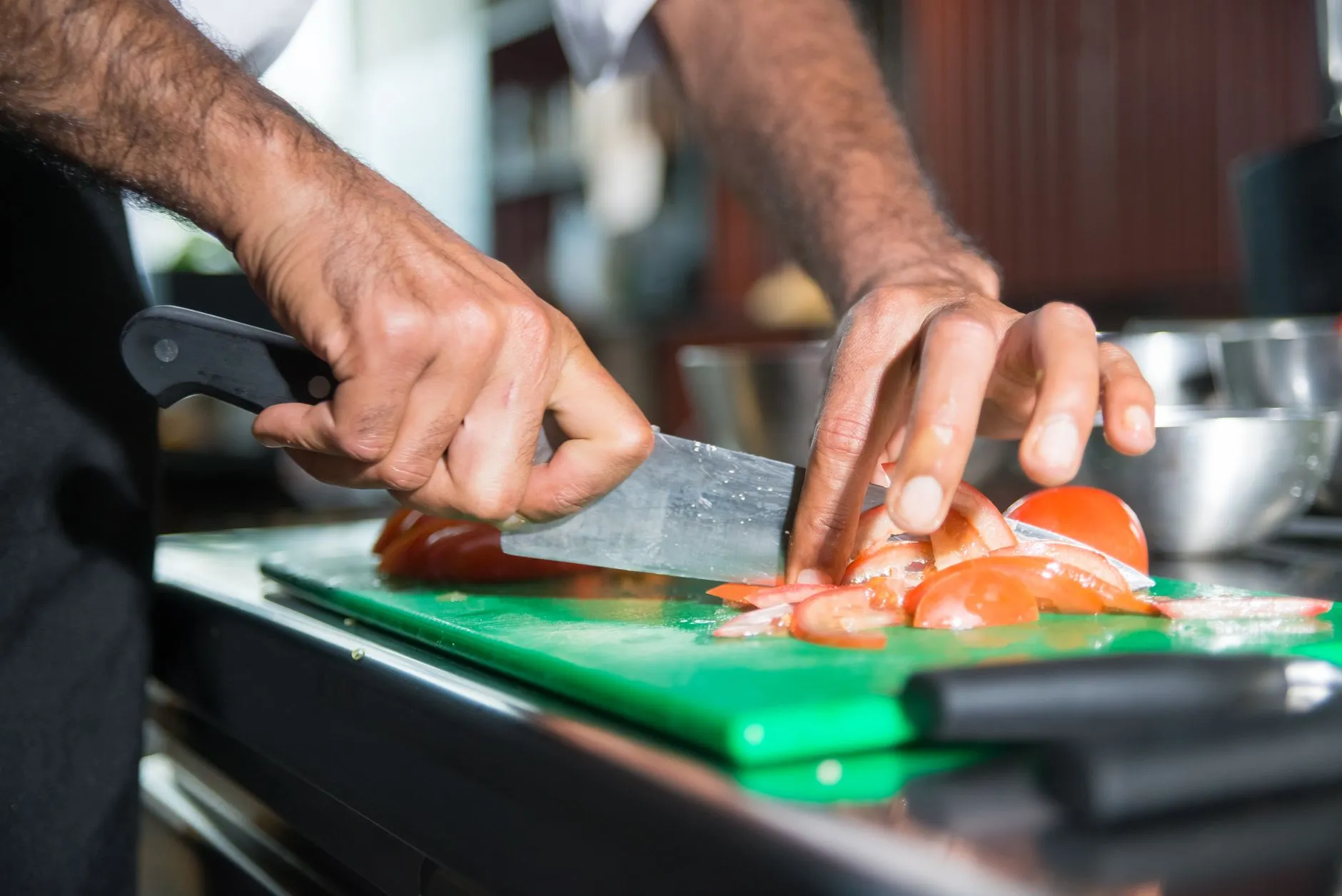
Set a ripe tomato on the board and lay the blade on the skin with no downward pressure. Draw it back. It should bite in on its own. If it skates across the surface, the edge is gone.
Run a thumbnail lightly across the edge, not along it. A sharp edge catches. A dull one feels smooth and rounded, like the back of the blade.
If you’re pushing harder than you used to, that’s the answer too. That extra force is also the reason a dull knife is the more dangerous one. A blade that needs pressure is a blade that slips with pressure behind it (University of Rochester Medical Center).
Can you sharpen too often?
You can. Every sharpening takes a thin layer of steel off the bevel, so an annual habit costs a good knife almost nothing over decades. Monthly trips to a heavy grinder are a different story.
The bigger risk isn’t frequency. It’s who does the work. A dry high-speed wheel can heat steel past its temper and soften the edge permanently, and no schedule fixes that. Sharpening at the right interval by the wrong method is worse than waiting an extra six months.
The bottom line
Stop watching the calendar and start watching the tomato. Hone your daily knife regularly, keep it off glass and stone, and book a proper sharpening when honing stops bringing the edge back. For most Midtown kitchens that lands somewhere between six and twelve months on the workhorse knife, and longer on everything else.
When it’s time, we do it by hand and water-cooled here in Midtown Toronto, usually same day. Bring the whole block if it’s been a while. Most of it probably doesn’t need us yet.